



Trideset godina.
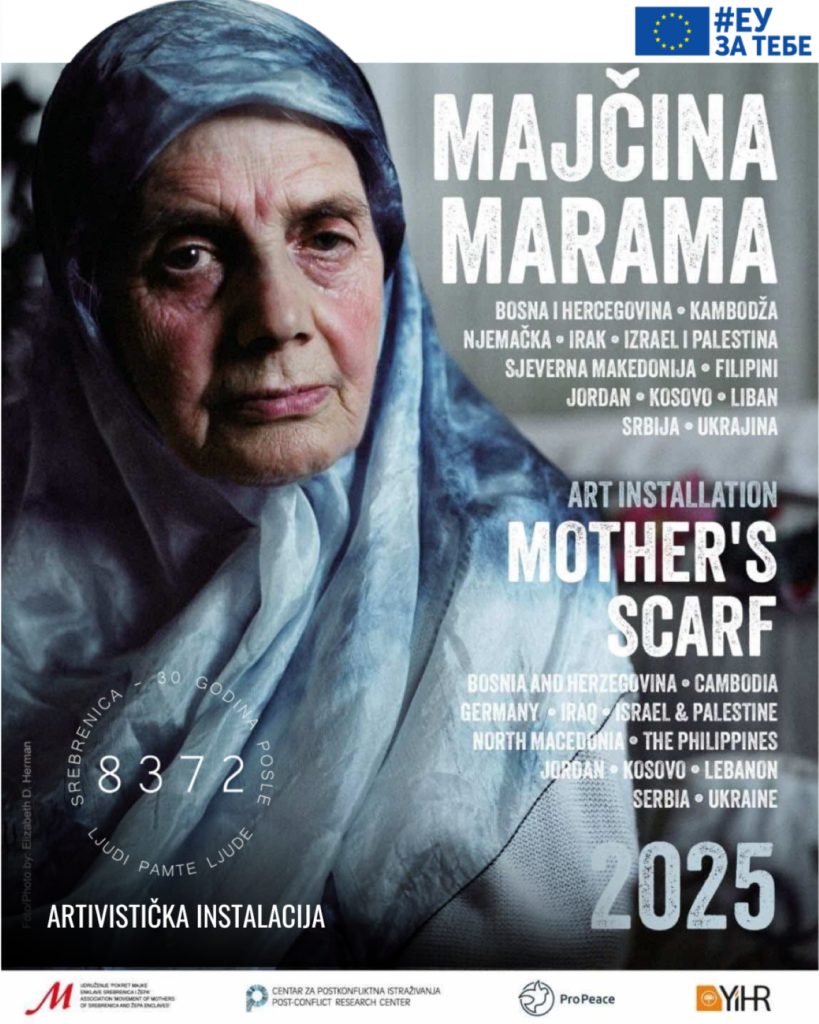
Prošlo je trideset godina otkako su u julu 1995. nestali sinovi iz avlija, braća iz soba, muževi iz kreveta, komšije iz autobusa, đaci iz učionica.
Od kada su ubijani redom, sistematski, bez izuzetka – ne po krivici, već po imenu.
Trideset godina otkako je u Srebrenici počinjen genocid – zločin osmišljen ne samo da ubije, već da izbriše. Da iz zemlje, istorije i sećanja pokuša da ukloni svaki trag postojanja jednog naroda, jednog imena, jednog pogleda u oči.
Jer kad ubiješ telo, ostaje ime.
Kad zatrpaš kosti, ostaju fotografije.
Kad premestiš grobnice, ostaju majke.
Zato su pokušali da uklone i ono poslednje – sećanje.
Trideset godina otkako majke hodaju bez pogleda, bez tela, bez pravde.
A mi danas stojimo u Beogradu – gradu koji živi iznad neizgovorenog, s obe noge na potisnutom. Gde se najglasnije ćuti. Gde se ne govori o žrtvama, već se polemiše o terminima. Gde se pravi da nije čuo njihov krik.
Zato širimo „Majčinu Maramu“ – artivističku instalaciju sačinjenu od hiljada marama prikupljenih proteklih godina.
Širimo ih istovremeno u desetinama gradova i zemalja: Sarajevu, Berlinu, Prištini, Skoplju, Amanu, Bagdadu, Pnom Penu…
U Bosni i Hercegovini, Srbiji, Nemačkoj, Kosovu, Severnoj Makedoniji, Jordanu, Iraku, Kambodži i mnogim drugim mestima.
Jer pamćenje ne poznaje granice.
Jer ljudskost ne traži pasoš.
U Beogradu je danas samo jedan deo sa nama – ali svaka od njih stoji kao 8.372 pitanja koja čekaju odgovor.
U svakoj marami je život koji je prekinut, a potom pokušan da se izbriše.
To su marame u kojima su majke čekale da im se deca vrate. U kojima su tragale po masovnim grobnicama. U kojima su dočekivale presude koje kasne decenijama.
U kojima su preživele.
U kojima su umrle, bez odgovora na pitanje: zašto baš on?
Ove marame nisu ukrasi.
One su otpor.
Sećanje koje probada kroz zaborav.
Oni nisu brojevi.
Njih 8.372 puta – jedno ime, jedan život, jedno „volim te mama“, jedno „hoću da budem učitelj“, jedno „neću da me vode“, jedno „reci im da sam živ“.
I nijedno nije vraćeno.
To su rečenice koje nisu stigle da se izgovore.
To su ruke koje nisu stigle da zagrle.
Ova instalacija to pamćenje razvlači preko glavnog trga ovog grada.
Beograd, koji je decenijama gledao kroz prste, sada mora da pogleda pravo u oči.
Ne da bismo optuživali narod – već da bismo sačuvali ljudskost.
Jer ono što ubija duže od metka jeste sistem koji odbija da prizna.
Trideset godina nas uče da je opasno reći istinu.
Da je „provokacija“ pomenuti imena ubijenih.
Da se sećanjem „napada nacija“.
Ali istina nije napad.
Istina je obaveza.
Oni koji su ubijeni nisu imali ni pravdu, ni oproštaj, ni mogućnost da ispričaju svoju priču.
Zato pričamo mi.
Dok Beograd i dalje raspravlja o terminima i brojevima, mi vezujemo marame – za svakog ko je bio vezan i odveden. Za svakog ko je zavezan u tišini.
Svaka marama je veza – između mrtvih i živih.
Između prošlosti i onoga što mora da dođe.
Između istine – i betonskog zida poricanja pred kojim stojimo.
Jer genocid ne prestaje kad se završi ubijanje.
Genocid traje dok se poriče.
Dok se brani.
Dok su svedoci pretnja, a ubice „kontroverzne ličnosti“ sa specijalnim tretmanom – ili, još gore, heroji.
Genocid traje – ovde, danas, sada – kada predsednik države odbija da kaže „žao mi je“.
Kada škole ćute o Srebrenici.
Kada se preziru oni koji podsećaju.
„Majčina Marama“ je podsetnik – da smo svi odgovorni.
I da niko više nikada ne sme biti zatrpan zemljom i ćutanjem.
„Majčina Marama“ ne pita: ko si ti?
Već: koga si spreman da pamtiš?
I da li umeš da budeš čovek – kad je najteže?
Ljudi pamte ljude.
Zato pamtimo.
Zbog njih. Zbog nas. Zbog svega što dolazi posle.
Trideset godina posle.
Dalia Koler je mlada aktivistkinja i novomedijska umetnica iz Novog Sada. Kroz snažan angažman u Inicijativi mladih za ljudska prava i na međunarodnim festivalima, koristi različite umetničke discipline, aktivizam i rad sa mladima kao metode u procesima tranzicione pravde, ljudskih prava, suočavanja s prošlošću i izgradnje mira na Balkanu.
Dalia Koler (dwp)
‘Mother’s Scarf’ – People Remember People
Thirty Years.
It’s been thirty years since, in July 1995, sons vanished from courtyards, brothers from bedrooms, husbands from beds, neighbors from buses, students from classrooms.
Since they were killed – systematically, indiscriminately – not for what they had done, but for who they were.
Thirty years since genocide was committed in Srebrenica – a crime designed not only to kill, but to erase. To remove every trace of a people, a name, a glance – from the land, from history, and from memory.
Because when you kill a body, a name remains.
When you bury bones, photographs remain.
When you move graves, mothers remain.
And so they tried to erase even the last thing – memory.
Thirty years since mothers have walked without a gaze, without bodies, without justice.
And today, we stand in Belgrade – a city built atop the unspoken, with both feet on what has been buried.
A city where silence is loudest.
Where victims are ignored, and semantics debated.
Where cries are met with indifference.
That is why we are spreading „Mother’s Scarf“ – an artivist installation made of thousands of scarves collected over the past years.
We stretch them simultaneously across dozens of cities and countries:
Sarajevo, Berlin, Prishtina, Skopje, Amman, Baghdad, Phnom Penh…In Bosnia and Herzegovina, Serbia, Germany, Kosovo, North Macedonia, Jordan, Iraq, Cambodia, and many others.
Because memory knows no borders.
Because humanity needs no passport.
Only a part of them is here with us in Belgrade today –but each one stands as 8,372 unanswered questions.
In every scarf, there is a life interrupted – and then attempted to be erased.
Scarves in which mothers waited for their children to return.
Scarves in which they searched mass graves.
Scarves in which they awaited verdicts that arrived decades late.
Scarves in which they survived.
Scarves in which they died – never knowing why it had to be him.
These scarves are not ornaments.
They are resistance.
Memory that pierces through forgetting.
They are not numbers.
8,372 times – one name, one life, one “I love you, Mom”, one “I want to be a teacher”, one “Don’t let them take me”, one “Tell them I’m alive.”
None of them returned.
These are the words that were never spoken.
The arms that never got to hug.
This installation stretches that memory across the main square of this city.
Belgrade – which for decades looked the other way – must now look directly into the eyes.
Not to accuse a nation – but to preserve our humanity.
Because what kills longer than a bullet is a system that refuses to acknowledge.
For thirty years, we’ve been taught that truth is dangerous.
That mentioning the names of the murdered is a “provocation.”
That remembrance is an “attack on the nation.”
But truth is not an attack.
Truth is an obligation.
Those who were killed had no justice, no forgiveness, no chance to tell their story.
So we speak.
While Belgrade still debates terminology and numbers, we tie scarves –for each person who was bound and taken.
For each one tied into collective silence.
Each scarf is a link – between the dead and the living.
Between the past and what must come.
Between truth – and the concrete wall of denial before which we now stand.
Because genocide does not end when the killing stops.
Genocide continues while it is denied.
While it is defended.
While witnesses are threats, and perpetrators are “controversial figures” with special treatment – or worse, heroes.
Genocide continues – here, today, now –when the President refuses to say “I’m sorry.”
When schools are silent about Srebrenica.
When society scorns those who remember.
„Mother’s Scarf“ is a reminder – that we are all responsible.
And that no one should ever again be buried by earth and silence.
„Mother’s Scarf“ does not ask: Who are you?
It asks: Whom are you willing to remember?
And can you be human – when it’s hardest to be?
People remember people.
So we remember.
For them.
For us.
For everything that comes after.
Thirty years after.
Dalia Koler is a young activist and new media artist from Novi Sad. Through strong engagement in the Youth Initiative for Human Rights and at international festivals, he uses various artistic disciplines, activism and work with young people as methods in the processes of transitional justice, human rights, dealing with the past and building peace in the Balkans.
Dalia Koler (dwp)

 STUPS: Ponuda